 Add to Chrome
 Add to Firefox
 Add to Edge
A Survey on LLM-based Conversational User Simulation
Apr 27, 2026
User simulation has long played a vital role in computer science due to its potential to support a wide range of applications. Language, as the primary medium of human communication, forms the foundation of social interaction and behavior. Consequently, simulating conversational behavior has become a key area of study. Recent advancements in large language models (LLMs) have significantly catalyzed progress in this domain by enabling high-fidelity generation of synthetic user conversation. In this paper, we survey recent advancements in LLM-based conversational user simulation. We introduce a novel taxonomy covering user granularity and simulation objectives. Additionally, we systematically analyze core techniques and evaluation methodologies. We aim to keep the research community informed of the latest advancements in conversational user simulation and to further facilitate future research by identifying open challenges and organizing existing work under a unified framework.

Sparse Personalized Text Generation with Multi-Trajectory Reasoning
Apr 27, 2026As Large Language Models (LLMs) advance, personalization has become a key mechanism for tailoring outputs to individual user needs. However, most existing methods rely heavily on dense interaction histories, making them ineffective in cold-start scenarios where such data is sparse or unavailable. While external signals (e.g., content of similar users) can offer a potential remedy, leveraging them effectively remains challenging: raw context is often noisy, and existing methods struggle to reason over heterogeneous data sources. To address these issues, we introduce PAT (Personalization with Aligned Trajectories), a reasoning framework for cold-start LLM personalization. PAT first retrieves information along two complementary trajectories: writing-style cues from stylistically similar users and topic-specific context from preference-aligned users. It then employs a reinforcement learning-based, iterative dual-reasoning mechanism that enables the LLM to jointly refine and integrate these signals. Experimental results across real-world personalization benchmarks show that PAT consistently improves generation quality and alignment under sparse-data conditions, establishing a strong solution to the cold-start personalization problem.
Trust but Verify: Introducing DAVinCI -- A Framework for Dual Attribution and Verification in Claim Inference for Language Models
Apr 23, 2026Large Language Models (LLMs) have demonstrated remarkable fluency and versatility across a wide range of NLP tasks, yet they remain prone to factual inaccuracies and hallucinations. This limitation poses significant risks in high-stakes domains such as healthcare, law, and scientific communication, where trust and verifiability are paramount. In this paper, we introduce DAVinCI - a Dual Attribution and Verification framework designed to enhance the factual reliability and interpretability of LLM outputs. DAVinCI operates in two stages: (i) it attributes generated claims to internal model components and external sources; (ii) it verifies each claim using entailment-based reasoning and confidence calibration. We evaluate DAVinCI across multiple datasets, including FEVER and CLIMATE-FEVER, and compare its performance against standard verification-only baselines. Our results show that DAVinCI significantly improves classification accuracy, attribution precision, recall, and F1-score by 5-20%. Through an extensive ablation study, we isolate the contributions of evidence span selection, recalibration thresholds, and retrieval quality. We also release a modular DAVinCI implementation that can be integrated into existing LLM pipelines. By bridging attribution and verification, DAVinCI offers a scalable path to auditable, trustworthy AI systems. This work contributes to the growing effort to make LLMs not only powerful but also accountable.
Test-Time Strategies for More Efficient and Accurate Agentic RAG
Mar 12, 2026Retrieval-Augmented Generation (RAG) systems face challenges with complex, multihop questions, and agentic frameworks such as Search-R1 (Jin et al., 2025), which operates iteratively, have been proposed to address these complexities. However, such approaches can introduce inefficiencies, including repetitive retrieval of previously processed information and challenges in contextualizing retrieved results effectively within the current generation prompt. Such issues can lead to unnecessary retrieval turns, suboptimal reasoning, inaccurate answers, and increased token consumption. In this paper, we investigate test-time modifications to the Search-R1 pipeline to mitigate these identified shortcomings. Specifically, we explore the integration of two components and their combination: a contextualization module to better integrate relevant information from retrieved documents into reasoning, and a de-duplication module that replaces previously retrieved documents with the next most relevant ones. We evaluate our approaches using the HotpotQA (Yang et al., 2018) and the Natural Questions (Kwiatkowski et al., 2019) datasets, reporting the exact match (EM) score, an LLM-as-a-Judge assessment of answer correctness, and the average number of turns. Our best-performing variant, utilizing GPT-4.1-mini for contextualization, achieves a 5.6% increase in EM score and reduces the number of turns by 10.5% compared to the Search-R1 baseline, demonstrating improved answer accuracy and retrieval efficiency.
InfinityStory: Unlimited Video Generation with World Consistency and Character-Aware Shot Transitions
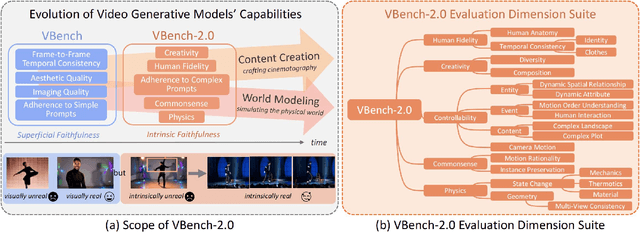
Mar 04, 2026Generating long-form storytelling videos with consistent visual narratives remains a significant challenge in video synthesis. We present a novel framework, dataset, and a model that address three critical limitations: background consistency across shots, seamless multi-subject shot-to-shot transitions, and scalability to hour-long narratives. Our approach introduces a background-consistent generation pipeline that maintains visual coherence across scenes while preserving character identity and spatial relationships. We further propose a transition-aware video synthesis module that generates smooth shot transitions for complex scenarios involving multiple subjects entering or exiting frames, going beyond the single-subject limitations of prior work. To support this, we contribute with a synthetic dataset of 10,000 multi-subject transition sequences covering underrepresented dynamic scene compositions. On VBench, InfinityStory achieves the highest Background Consistency (88.94), highest Subject Consistency (82.11), and the best overall average rank (2.80), showing improved stability, smoother transitions, and better temporal coherence.
Blind to the Human Touch: Overlap Bias in LLM-Based Summary Evaluation
Feb 07, 2026Large language model (LLM) judges have often been used alongside traditional, algorithm-based metrics for tasks like summarization because they better capture semantic information, are better at reasoning, and are more robust to paraphrasing. However, LLM judges show biases for length and order among others, and are vulnerable to various adversarial input prompts. While recent studies have looked into these biases, few have analyzed them at a more granular level in relation to a well-defined overlap metric. In this work we provide an LLM judge bias analysis as a function of overlap with human-written responses in the domain of summarization. We test 9 recent LLMs with parameter counts ranging from 1 billion to 12 billion, including variants of Gemma 3 and LLaMA 3. We find that LLM judges increasingly prefer summaries generated by other LLMs over those written by humans as the similarities (as measured by ROUGE and BLEU) between the judged summaries decrease, and this pattern extends to all but one model tested, and exists regardless of the models' own position biases. Additionally, we find that models struggle to judge even summaries with limited overlaps, suggesting that LLM-as-a-judge in the summary domain should rely on techniques beyond a simple comparison.
Structured Uncertainty guided Clarification for LLM Agents
Nov 11, 2025LLM agents extend large language models with tool-calling capabilities, but ambiguous user instructions often lead to incorrect invocations and task failures. We introduce a principled formulation of structured uncertainty over tool-call parameters, modeling joint tool-argument clarification as a POMDP with Expected Value of Perfect Information (EVPI) objective for optimal question selection and aspect-based cost modeling to prevent redundancy. Our SAGE-Agent leverages this structured uncertainty to achieve superior efficiency: increasing coverage on ambiguous tasks by 7-39\% while reducing clarification questions by 1.5-2.7$\times$ compared to strong prompting and uncertainty-based baselines. We present ClarifyBench, the first multi-turn tool-augmented disambiguation benchmark with realistic LLM-based user simulation across diverse domains including document editing, vehicle control, and travel booking. Additionally, we demonstrate that structured uncertainty provides effective training signals for reinforcement learning, boosting When2Call accuracy from 36.5\% to 65.2\% (3B model) and 36.7\% to 62.9\% (7B model) through uncertainty-weighted GRPO training. These results establish structured uncertainty as a principled, efficient approach for tool-augmented agents, improving both task success and interaction efficiency in real-world scenarios.
Decomposition-Enhanced Training for Post-Hoc Attributions In Language Models
Oct 29, 2025Large language models (LLMs) are increasingly used for long-document question answering, where reliable attribution to sources is critical for trust. Existing post-hoc attribution methods work well for extractive QA but struggle in multi-hop, abstractive, and semi-extractive settings, where answers synthesize information across passages. To address these challenges, we argue that post-hoc attribution can be reframed as a reasoning problem, where answers are decomposed into constituent units, each tied to specific context. We first show that prompting models to generate such decompositions alongside attributions improves performance. Building on this, we introduce DecompTune, a post-training method that teaches models to produce answer decompositions as intermediate reasoning steps. We curate a diverse dataset of complex QA tasks, annotated with decompositions by a strong LLM, and post-train Qwen-2.5 (7B and 14B) using a two-stage SFT + GRPO pipeline with task-specific curated rewards. Across extensive experiments and ablations, DecompTune substantially improves attribution quality, outperforming prior methods and matching or exceeding state-of-the-art frontier models.
A Survey on Long-Video Storytelling Generation: Architectures, Consistency, and Cinematic Quality
Jul 09, 2025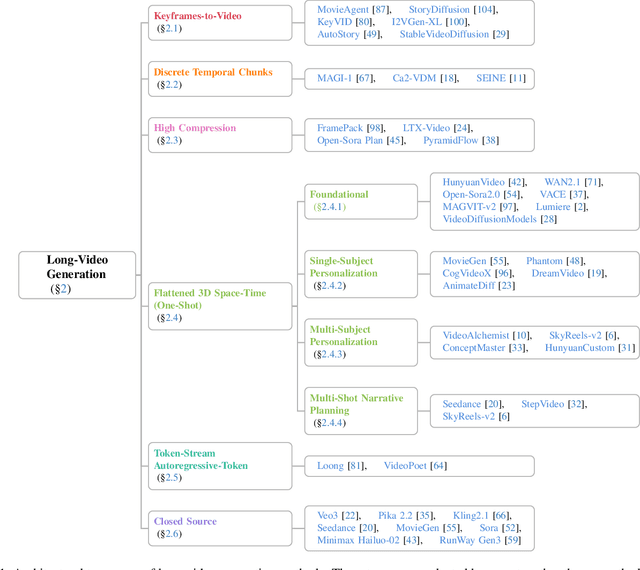
Despite the significant progress that has been made in video generative models, existing state-of-the-art methods can only produce videos lasting 5-16 seconds, often labeled "long-form videos". Furthermore, videos exceeding 16 seconds struggle to maintain consistent character appearances and scene layouts throughout the narrative. In particular, multi-subject long videos still fail to preserve character consistency and motion coherence. While some methods can generate videos up to 150 seconds long, they often suffer from frame redundancy and low temporal diversity. Recent work has attempted to produce long-form videos featuring multiple characters, narrative coherence, and high-fidelity detail. We comprehensively studied 32 papers on video generation to identify key architectural components and training strategies that consistently yield these qualities. We also construct a comprehensive novel taxonomy of existing methods and present comparative tables that categorize papers by their architectural designs and performance characteristics.
LaMP-Cap: Personalized Figure Caption Generation With Multimodal Figure Profiles
Jun 06, 2025Figure captions are crucial for helping readers understand and remember a figure's key message. Many models have been developed to generate these captions, helping authors compose better quality captions more easily. Yet, authors almost always need to revise generic AI-generated captions to match their writing style and the domain's style, highlighting the need for personalization. Despite language models' personalization (LaMP) advances, these technologies often focus on text-only settings and rarely address scenarios where both inputs and profiles are multimodal. This paper introduces LaMP-Cap, a dataset for personalized figure caption generation with multimodal figure profiles. For each target figure, LaMP-Cap provides not only the needed inputs, such as figure images, but also up to three other figures from the same document--each with its image, caption, and figure-mentioning paragraphs--as a profile to characterize the context. Experiments with four LLMs show that using profile information consistently helps generate captions closer to the original author-written ones. Ablation studies reveal that images in the profile are more helpful than figure-mentioning paragraphs, highlighting the advantage of using multimodal profiles over text-only ones.